Place first.
The mountain, the people and the history come before marketing language.
VENEZUELAN COFFEE · ORIGIN BY ORIGIN
SAMAN ORIGINS reconnects overlooked Venezuelan coffee communities with Europe through exceptional coffee, transparent trade, documentary storytelling and a model designed to reinvest success at origin.
WHY SAMAN ORIGINS EXISTS
In the nineteenth century, coffee connected Venezuelan mountain communities to global trade. Oil later changed the country's economic center of gravity and traditional agricultural exports lost international visibility.
SAMAN ORIGINS is not built on nostalgia or charity. It starts with a simple commercial truth: excellent coffee creates durable value when people genuinely want to drink it. Our work is to make origin, quality and evidence visible again.
The mountain, the people and the history come before marketing language.
The relationship begins with a real product, a real market and repeat demand.
When the coffee succeeds, the mission gains more capacity to work at origin.

Samanea samanShade · canopy · continuity
THE NAME & THE MARK
The samán, Samanea saman, is native to northern tropical South America, including Venezuela. Its immense umbrella-shaped crown has long made it a tree of shade and gathering across the tropics.
Botanical and agroforestry references record its use as shade in coffee and cacao systems. The connection is especially resonant in Aragua, home to both our first origin and the historic Samán de Güere.
The tree is not our mascot. It is our model: build a canopy around the coffee without becoming the crop itself.
Give the origin more room to be seen.
Stay specific to place while helping the coffee travel.
Build relationships that matter beyond one release.
ORIGIN 001 · ARAGUA, VENEZUELA
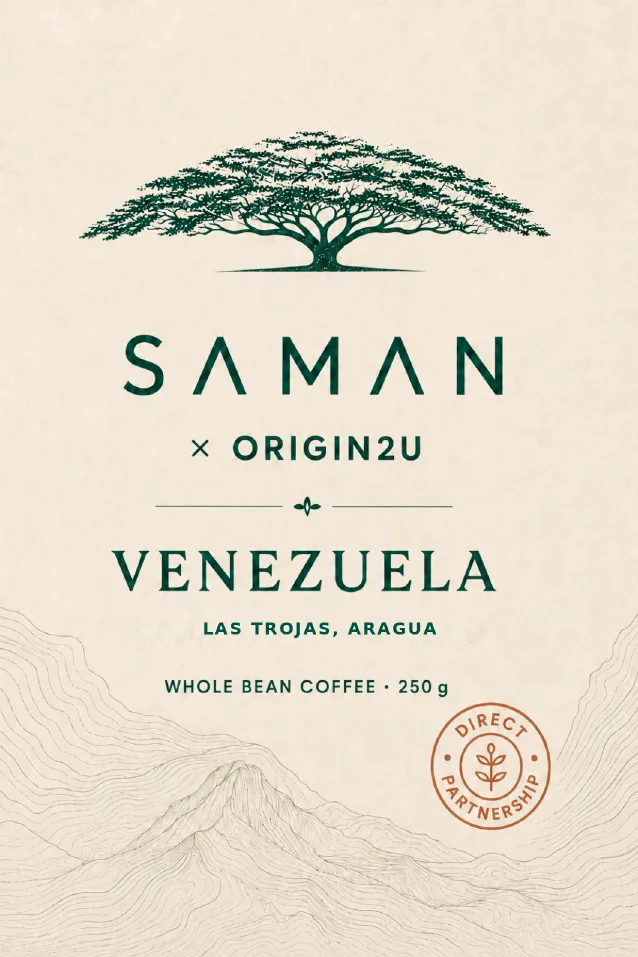
Our first chapter begins inside the cloud forest of Henri Pittier National Park with the Asociación de Productores de Las Trojas.

Origin2U lists this lot as coffee from Asociación Las Trojas, grown in Aragua inside Henri Pittier National Park. The broader association profile describes high-elevation farms, manual picking and a November-February harvest.
The terrain is not decorative storytelling. Origin2U reports that motorized vehicles are not permitted in the producers' area, so coffee and supplies may move by mule. Some descents toward Turmero take roughly 2.5 hours one way.
THE PEOPLE BEHIND THE PLACE
Origin2U publicly identifies families and estates within the Las Trojas community. The documentary will let the association tell its own story in its own voice; until then, we publish only what we can substantiate.
VENEZUELAN COFFEE · THE LONG STORY
Venezuelan coffee is not a new specialty discovery. It is the return of an origin that once played a major role in the world coffee economy.
Coffee arrives in Venezuela during the eighteenth century and eventually surpasses cacao in economic importance.
Coffee helps reconnect the country to international trade and spreads through mountain regions.
Historical research records Venezuela as the world's third-largest coffee exporter, responsible for roughly 6.5% of global exports.
Petroleum becomes the dominant source of foreign exchange and shifts investment away from the agricultural export economy.
The producing culture never vanished. New producers, associations, buyers and roasters are reopening specialty export routes.
The knowledge stayed. The farms stayed.
The world simply stopped seeing them.Foundation formation in progress
THE SAMAN ORIGINS MODEL
SAMAN ORIGINS is being established as a non-profit foundation in Poland. The intended model is straightforward: cover the real costs of making and distributing excellent coffee, then reinvest the platform's remaining surplus into its mission instead of distributing it to private owners.
The relationship starts with a real product and a real market. Producers should not need pity to make their coffee valuable.
Document place, history, people and practical reality. Let the customer understand what sits behind the cup.
Identify priorities with producers and use the project's growing capacity to support work that can actually matter at origin.
This is the intended operating model, not a claim that every euro of revenue becomes a donation. Coffee, roasting, packaging, logistics, staff, documentation and administration all have real costs. Transparency means showing those costs.
THE COFFEE HOUSES
SAMAN Coffee remains the commercial coffee-house network. The stores offer a low-friction first encounter with the brand, then open the door to deeper discovery through coffee, film, maps, objects and preparation.
The first SAMAN coffee house becomes the European home of Origin 001: tasting, documentary material, agricultural context and traditional café de manga alongside modern espresso.
A LIVING COFFEE CULTURE
The stores are contemporary coffee houses with the restraint of a gallery: a traditional Venezuelan cloth filter can sit naturally beside espresso and modern brewing. Culture is experienced through real objects, preparation and context rather than decoration.
THE DOCUMENTARY
Cloud forest. Paths. Families. Harvest. Processing. Mules. Memory. Local coffee rituals. The practical economics of getting a crop out of a protected mountain landscape. SAMAN's role is to help that story travel with the coffee, not to become its protagonist.
ORIGIN 001 · OPEN LEDGER
The long-term goal is to publish enough information that customers can distinguish facts, plans and outcomes. We would rather show an unfinished project honestly than manufacture a finished impact story.
Origin2U lot #102
Molenbergnatie
Poland
Film 001
No invented solution
THE FUTURE SHOP
The shop is being built around traceable releases rather than an endless catalogue. Each coffee should carry the place, people and evidence with it.
Aragua, Venezuela · whole bean
Leave your email and we will send one message when Origin 001 becomes available.
One release email. No newsletter noise.
EVIDENCE LEDGER
These are the main references behind the factual claims on this page. Plans belonging to SAMAN ORIGINS are presented as plans; facts about origin and history are linked to their sources.